What our data says about restroom loitering
.jpg)
Written by: Beth D'Arcy
Public restrooms have a bad rep. You know it’s bad when nearly 40% of people say they avoid eating or drinking to limit their use of a public restroom.
Most people associate public restrooms with sticky floors, vandalized stalls, doors without locks, and un-flushed toilets. And if a facility is in good shape, the assumption is that it’s only a matter of time before someone ruins it.
Vandalism and loitering in public restrooms do happen – but it gets worse when they aren’t regularly cleaned and maintained. It’s a hard cycle to break when the problem seems so unruly.
We’ve been digging into our data, and for Throne, it turns out that vandalism and overstays aren’t as widespread as people think. It’s actually a pretty manageable problem.
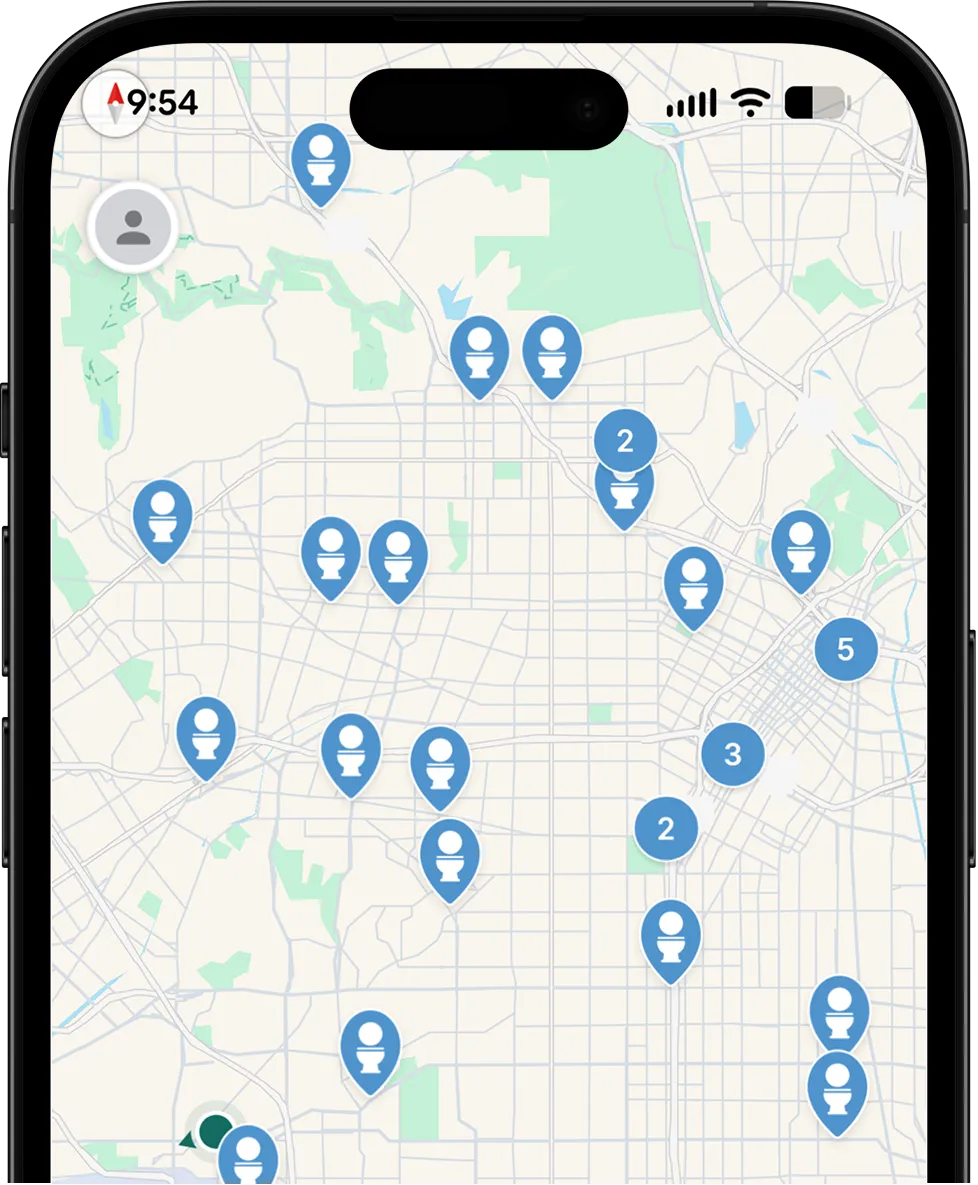
Since deploying smart public restrooms across 100+ locations, we’ve found the busiest restrooms are actually the most compliant, overstays are concentrated to a few locations, and targeted interventions are key to breaking the cycle of misuse.
About our data
To understand what actually drives misuse, we dug into our data looking at overstay rates from our fleet of Thrones in the LA market. We define an ‘overstay’ as someone staying in a Throne beyond 11 minutes.
Every Throne has a 10-minute time limit. The time limit is in place to discourage extended stays, keep the restroom available to others, and act as a safety measure in case of a medical emergency. We’ve found 10 minutes is plenty of time for most people using a public restroom. Across the Throne network, 81% of users complete their visit in under 5 minutes.
While the doors do open automatically after 10 minutes, we never want to catch anyone off guard. We give friendly overhead voice reminders at 5 and 8 minutes, and another at10 minutes letting them know time is up. If someone doesn’t leave after the door opens, our sensors count that as an overstay.
Here’s what our data shows about overstays:
The busiest restrooms are the most compliant
The busier the restroom, the worse it will be… right? That’s what most people assume, but our data says otherwise. The Thrones with highest usage are actually the most compliant with our overstay policy.
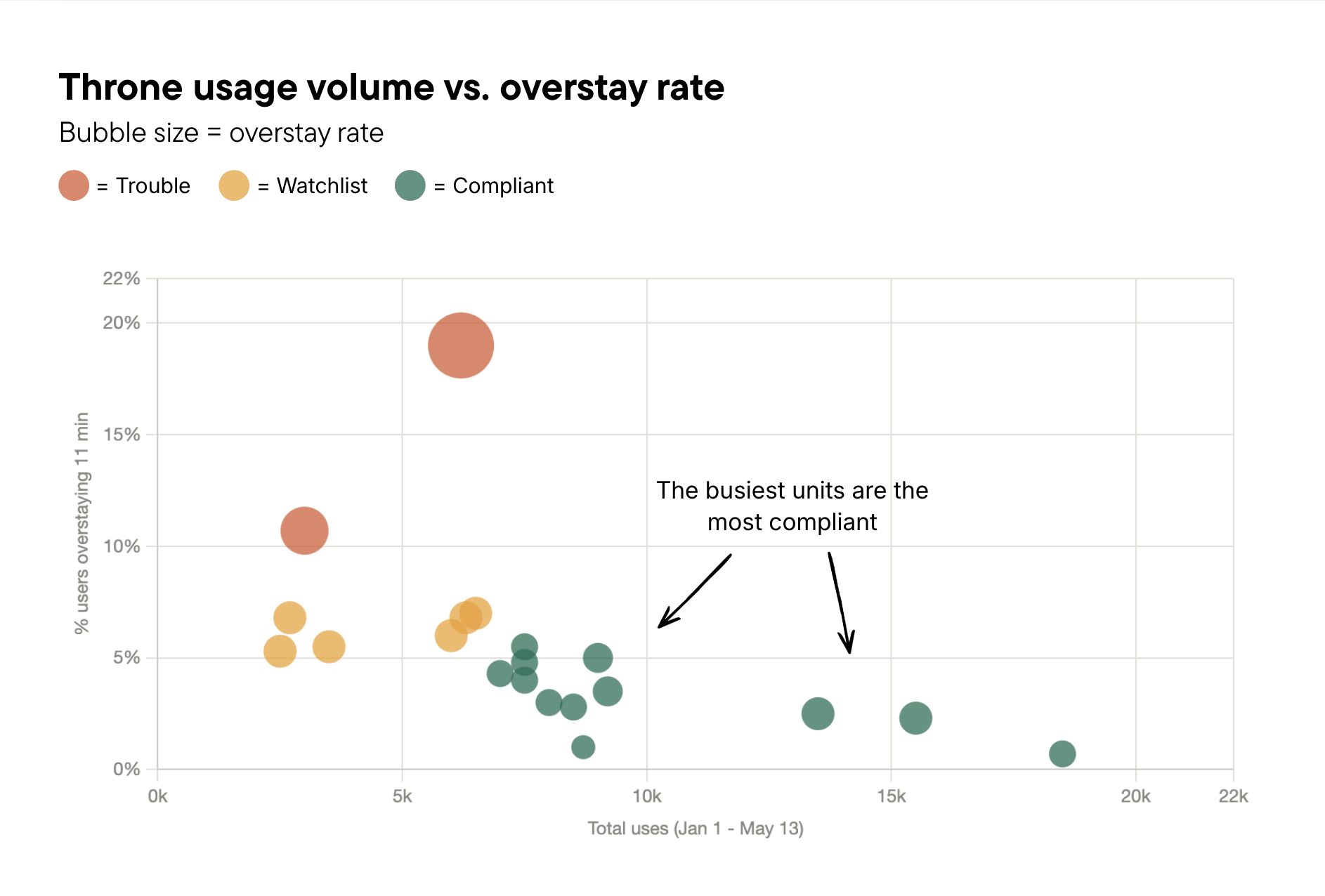
In our LA market, these high-usage units are located at commuter hubs and busiest during weekday rush hours. Thousands of people use these restrooms every week, yet they have the lowest overstay rates out of the entire fleet.
Issues with overstays are concentrated to just a handful of low-traffic units. This tells us that what drives misuse isn’t necessarily how busy a restroom is. The location and context matter more.
Overstays are concentrated, not widespread
Across the LA fleet, nearly a quarter of all 15-minute overstays across the fleet of 55 units come from just two locations.
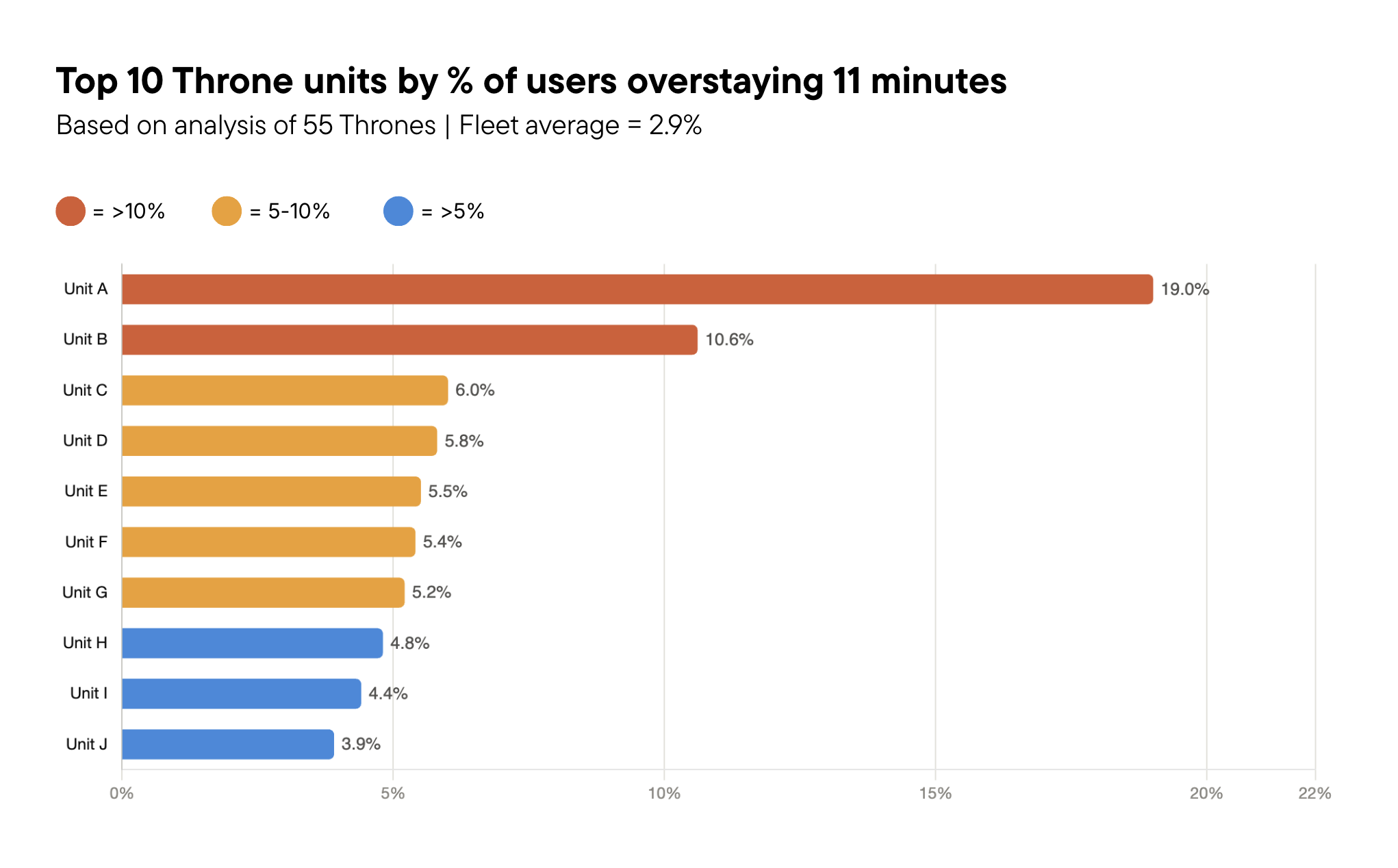
Looking closer, the problems at the two locations are actually quite different. Both see high volumes of overstays, but user behavior differs. When our system nudges them to move along 48% of overstayers leave between minutes 10 and 11 at one location. At the other, 62% do.
The overstay patterns are also different. One site sees overstays peak around midday on Thursdays and Fridays. At the other, misuse rises on weekday mornings. These patterns stay predictable and relatively consistent, which gives us a clear path to fixing the problem.
For example, after our data showed patterns of overstays at the Throne in LA Metro’s Westlake MacArthur Park Station, we decided to test a 5-minute limit instead of our typical 10-minute limit. Within the first 7 days, daily overstays dropped significantly: visits exceeding 6 minutes dropped 42% and visits exceeding 11 minutes dropped 57%. While these are early signs, our ability to gather this data at all enables us to understand the problem and test ways to fix it.
What makes restroom management sustainable?
"Our data shows how big an issue is and where it's concentrated, so we can come up with concrete interventions. Maybe a city decides they need attendants, but they only need them at two of 55 locations, not all 55." —Jess Heinzelman, Co-founder & COO, Throne Labs
Public restrooms are hard to manage because most cities aren’t able to measure the problem. Few cities dedicate line items to restroom operations, so labor, maintenance, and supplies get distributed across entire departments.
As a result, restroom cleaning, repairs, and updates get neglected, and the facilities become more vulnerable to vandalism and loitering.
The Broken Windows Theory says that even a small problem, like a broken window or graffiti tag, can invite more destruction. It’s these smaller issues that can take a whole facility offline for weeks, even months.

Restroom misuse may look like it’s widespread until you look at the data. Breaking down the problem means cities can target resources and develop interventions for just a few trouble locations.
When these critical facilities are well maintained and behaviors of misuse are quickly addressed, public restrooms become a public good.
Continue reading: How to stop public restroom misuse when no one’s watching