Do you know the real cost of a public restroom? Most cities don't
Written by: Jess Heinzelman, Co-founder & COO, Throne Labs
Ask a city budget manager what it costs to provide a public restroom, and they can probably give you a number. Ask them if they're confident in that number, and things get quieter.
A prefabricated single-stall restroom unit typically runs $100,000 to $185,000. That's the easy part. Install that unit on a busy downtown sidewalk or in a park a few hundred feet from the nearest sewer connection, and the total cost can balloon to $350,000 to $750,000 once you factor in utility hookups, engineering, permitting, ADA compliance, and site work. In cities like New York and San Francisco, the numbers climb further still, with individual restrooms on record as costing $1.7 million to $3.5 million each, figures that have made national headlines.
Build costs are at least visible. What's harder to see is what happens after the ribbon is cut.
The operating costs few cities track
Based on conversations with cities and public agencies of all sizes, from communities of 25,000 to 1M+ people, operating costs for a single public restroom average between $44,000 and $140,000* per year. Labor is the biggest driver, followed by supplies, utilities, maintenance, and emergency repairs.
But here's the problem: most cities don't actually track these costs at the restroom level.
Cleaning labor gets buried in departmental or citywide janitorial, maintenance, or operations budgets. Repair costs are absorbed into line items that cover everything from park benches to sprinkler systems. Paper goods disappear into a general supplies account. Nobody is breaking it out.
That opacity isn't a city's fault. It's a structural reality. Few agencies have a dedicated restroom program. The work is distributed across various line items, and the cost follows, dispersed and difficult to isolate.
The result is that decision-makers often don't know what they're actually spending, which makes it nearly impossible to evaluate whether the investment is working or to justify expanding it.
Philadelphia: A case study
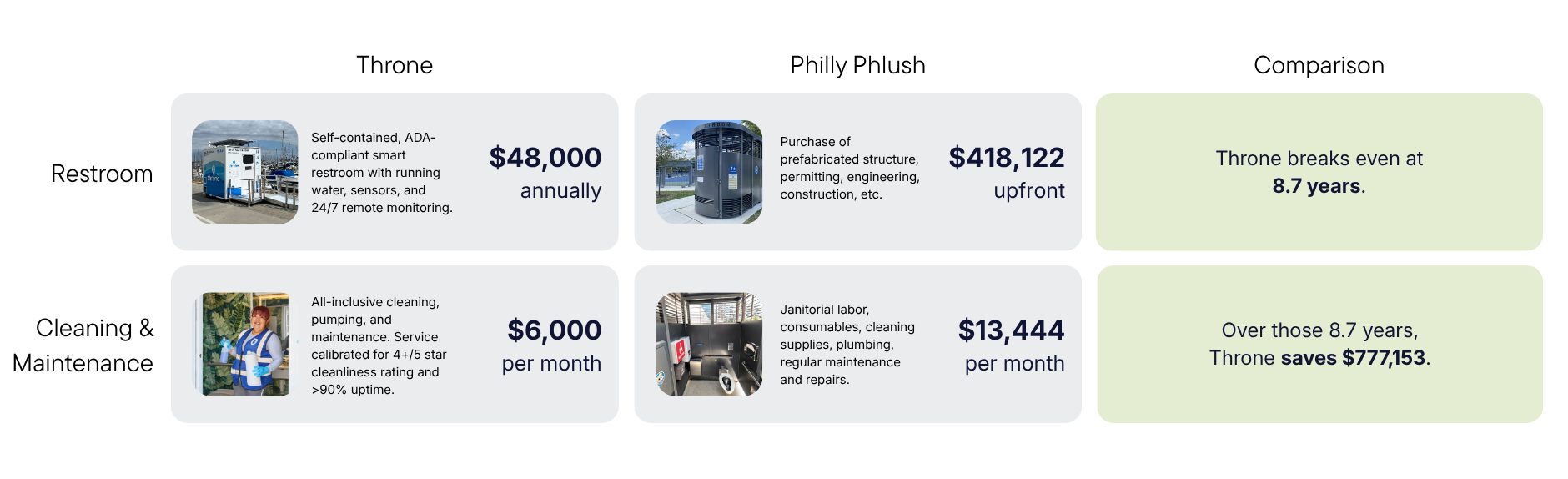
Philadelphia's Philly Phlush program is one of the clearest attempts to put real numbers to public restroom provision. The city launched a pilot in 2023 calling for six Portland Loo units to be installed across Philadelphia over five years at an annual cost of $656,864. Based on program documentation, that actual cost broke down to $418,122 per unit upfront ($168,320 for the unit itself, $249,802 for installation) and $161,328 per unit per year in labor, supplies, vehicles, and repairs each year.
Two units opened in the summer of 2023. Two years later, the city acknowledged it didn't have enough funding to see the full scope of the project through.
This isn't a failure of intent. It's a failure of structure: capital costs consume the budget, permitting and site work cause delays, and ongoing operating costs compete with everything else a city needs to fund.
Good intentions are not the bottleneck. Predictable, manageable cost structures are.
The quality gap nobody wants to talk about
Additionally, something that rarely appears in a cost comparison spreadsheet: the restrooms most cities build, at great expense, are ones people still try to avoid or they struggle to keep open.
A December 2025 audit by the New York City Council inspected 172 public restroom sites across all five boroughs and found exactly this. More than one in ten park restrooms were closed during posted operating hours. More than two in five open restrooms were missing at least one basic necessity, including soap, toilet paper, a garbage can, or a way to dry your hands. More than one in seven stalls lacked a functioning lock.
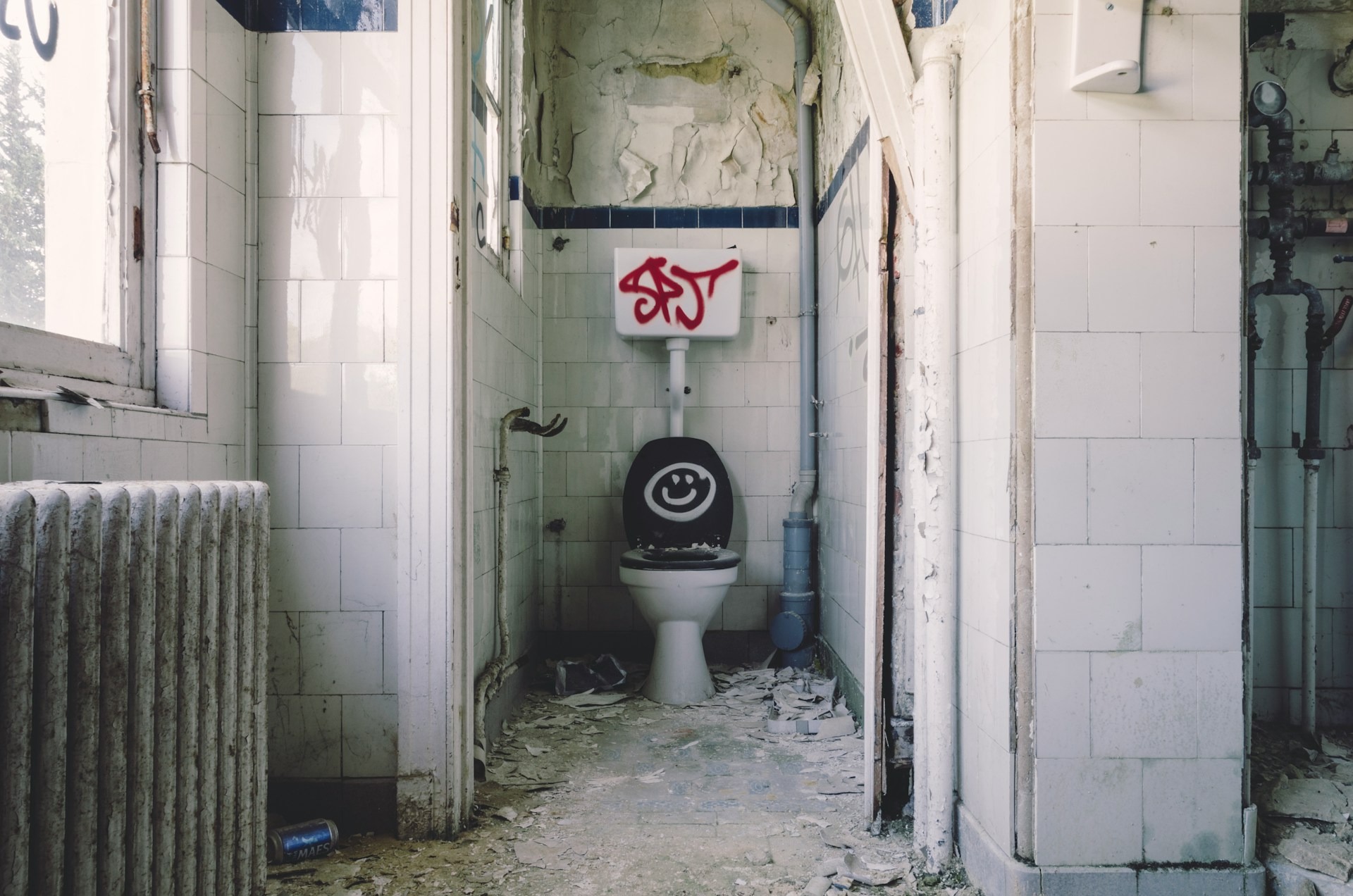
Spending $92,000 a year on average, the midpoint of the traditional operating range, doesn't guarantee a restroom will be enjoyable to use or even open.
Even when funded, public restrooms have become the option of last resort. The consequences have real impact: families leave parks before they're ready, parents miss the winning goal while zipping to Starbucks to pee, public defecation is on the rise, and small businesses absorb the burden of non-customers who have nowhere else to go.
This is what cities are getting for their investment. Spending $92,000 a year on average, the midpoint of the traditional operating range, doesn't guarantee a restroom will be enjoyable to use or even open. That cost is high, and still the community value falls short of what anyone actually wants.
A different way to think about restroom costs
Throne's model is built around making costs visible and predictable from the start, backed by results – delivering a restroom people love and will use with confidence.
Initially, we offered a single monthly cost for our turnkey rental and service. That often led to a look of shock that would quickly dissipate once staff broke down the math. Starting in FY27, we're separating the hardware from the service to make the comparison even clearer.
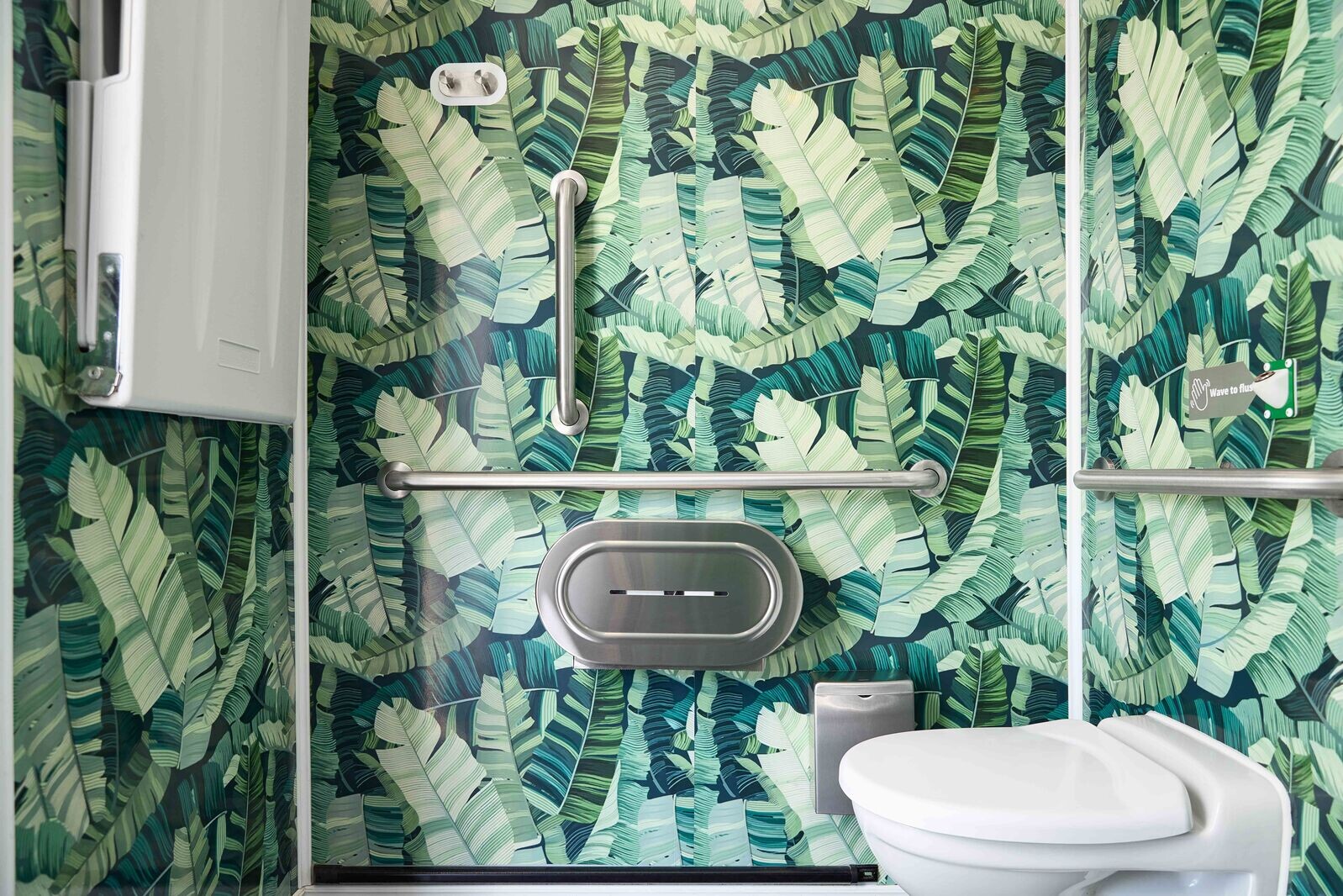
Renting a Throne unit gets a self-contained, ADA-compliant smart restroom with anti-graffiti coating, modular fixtures, our accountability platform, and our anti-loitering system, all as a straightforward annual line item.
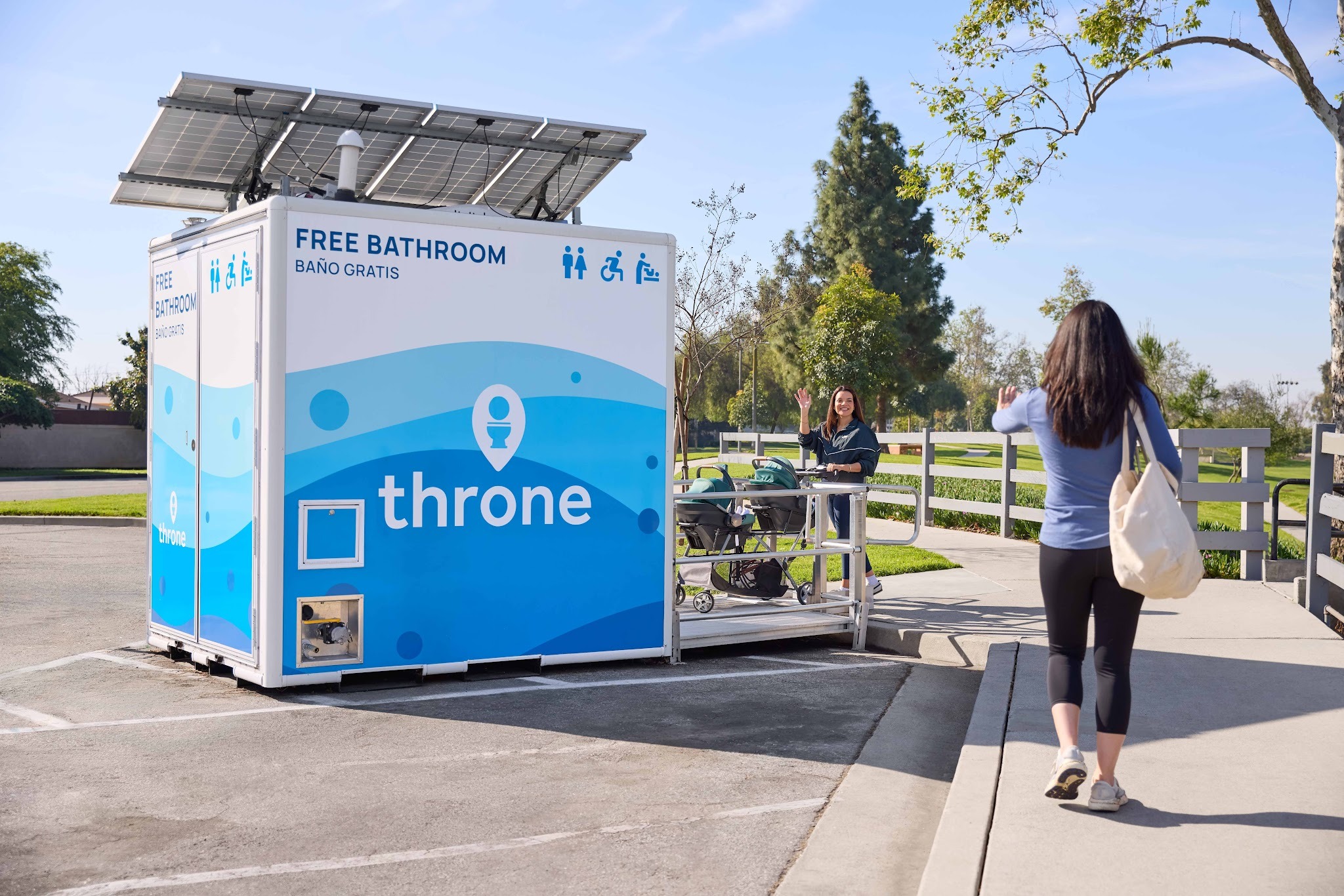
The service plan is then layered on top and calibrated to deliver a specific outcome: a cleanliness rating above 4 out of 5 stars and greater than 90% uptime. Not "we'll come by regularly." Not "we'll respond to complaints." A defined service level with a results-based quality target we share transparently.
All of it is all-inclusive: cleaning, pumping, maintenance, user support, supplies and repairs. We even cover vandalism, the big unknown that can blow up any restroom budget. Transparent costs and clear community results to show for it.
How would Throne Compare?
For a busy downtown restroom, Throne typically recommends the Scrub Ultra level that includes 4-5 cleans a day and assumes higher rates of vandalism and maintenance.
The real comparison
Traditional public restrooms cost cities between $78,000 and $192,000 per year per location when you factor in amortized capital over 15 years, labor, utilities, and maintenance. And that figure still doesn't capture the soft costs: city staff time managing vendors, running procurement cycles, scheduling, and responding to service failures.
Throne's all-inclusive model keeps it simple and predictable. More importantly, the outcome is different. Across our entire fleet, Throne restrooms average a 4.1 out of 5 star cleanliness rating and more than 90% uptime. These aren't targets we aspire to, they're the results our service tiers are engineered to deliver and that we track transparently with every partner.
That's the difference between a restroom people use in a pinch and one they're glad is there.
Public restrooms should not be a public grudge. They should be a public good. The first step to getting there is knowing what you're actually spending, and what you're actually getting for it.
*Estimated restroom costs provided by Throne customers and various Public Works RFPs from 2021 to 2025.